
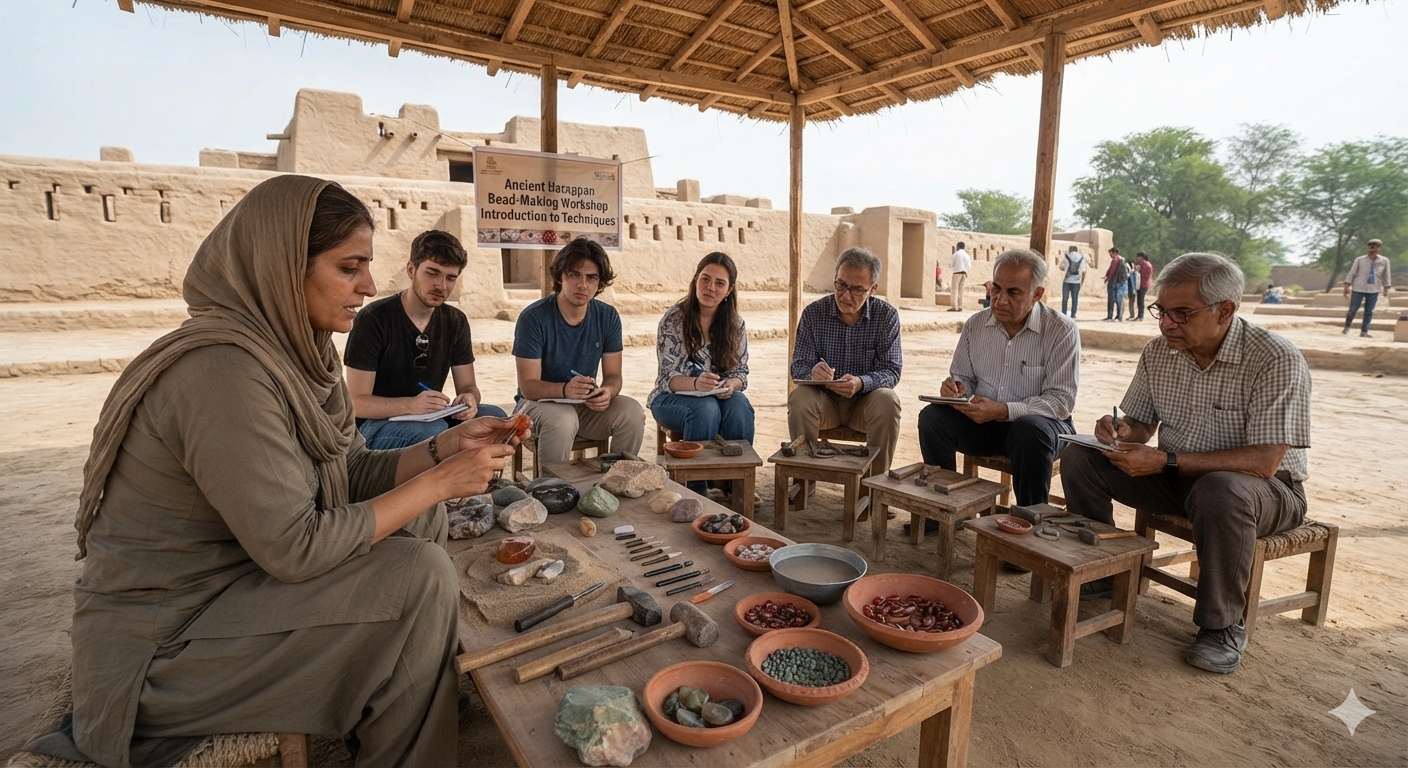
Lucknow: The Uttar Pradesh State Directorate of Archaeology has launched a two-day workshop on ancient bead-making techniques of the Harappan Civilisation, offering participants an opportunity to explore traditional craftsmanship through theoretical sessions and hands-on training.
The workshop, being held from October 22 to 23, 2026, was inaugurated with the lighting of a ceremonial lamp by Renu Dwivedi, Director of the Directorate of Archaeology, Lucknow; Anwar Hussain Sheikh, a national award-winning master trainer and stone craftsman from Khambhat, Gujarat; Pratap Bhai Parmar; Neetu Agrawal, Assistant Professor at Avadh Girls’ Degree College; and Ram Vinay.
Introducing the workshop, Dwivedi said its primary objective was to provide participants with both theoretical knowledge and practical experience of bead-making techniques practised during the Harappan Civilisation.
She explained that ancient beads were not merely ornaments but also important archaeological evidence of the technological expertise, artistic sensibilities, economic activities, trade connections and cultural life of early societies. Studying them helps researchers understand the advanced craftsmanship and technical achievements of ancient Indian civilisations.
More than 300 participants registered online for the workshop, of whom 150 were selected on a first-come, first-served basis. On the opening day, participants were organised into eight batches to ensure systematic training and adequate opportunities for practical learning.
Hands-On Training in Traditional Craftsmanship
A key feature of the workshop is its emphasis on practical demonstrations of traditional bead-making methods. Under the guidance of Sheikh and other experienced craftspeople from Khambhat, participants will learn various stages of production, including stone selection, shaping, grinding, polishing and drilling.

The sessions are designed to help participants appreciate the precision, patience, technical skill and scientific understanding required by ancient artisans to produce beads of accurate shapes and functional designs using traditional tools and methods.
The workshop is expected to be particularly beneficial for archaeology students, research scholars, teachers and individuals interested in traditional crafts. Practical exposure to bead-making processes can also help participants better understand archaeological artefacts, identify manufacturing techniques and undertake technical studies of ancient craft traditions.
Preserving Traditional Knowledge
Another important objective is to connect the practical experience of traditional artisans with academic and archaeological research. The initiative seeks to encourage documentation of indigenous knowledge, facilitate the transfer of skills between generations and strengthen efforts to preserve traditional techniques that risk being lost.
By combining historical study with hands-on learning, the workshop aims to make India’s cultural heritage a living source of knowledge rather than merely a record of the past.
The two-day programme represents an effort to promote awareness of ancient Indian craftsmanship, strengthen practical approaches to archaeological research and create opportunities for preserving and advancing traditional skills for future generations.












 https://www.youtube.com/watch?si=RtToJsBhYBatUrym&v=mOuYNSdhjHA&feature=youtu.be